Peak Digital Training is now offering bespoke sunset and night photography training on a 1 to 1 basis. Because this type of photography is so dependent on cloud and weather conditions, it allows us to be as flexible as possible and schedule the training at short notice. Dates available.
The training can take place at any mutually convenient time, and at various locations in the Derbyshire Peak District. As well as 1 to 1, the training can also be tailored for couples or small groups.
Prices start at £200.00 for a 5 hour session.
Please contact us if you would like more information, or to discuss your requirements.
Most photographers have tried to photograph a sunset at some point (many cameras even have a special “sunset” mode), but are more often than not disappointed with the results. On this workshop you’ll find out why this can happen, and learn some of the techniques that will make your sunset photos really come alive. Many of these same techniques also apply to twilight and night sky photography, and we will teach you how and when to use them.
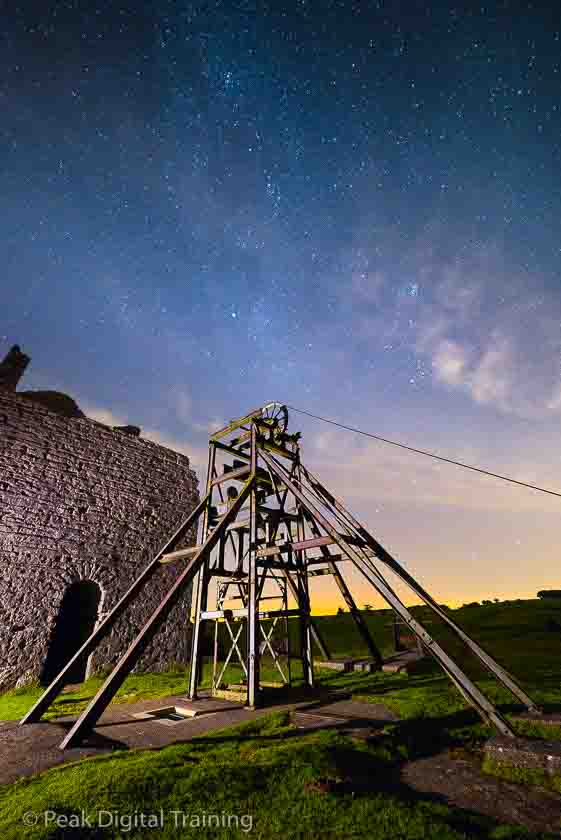
Modern digital cameras work extremely well in low light conditions, and have made night photography much easier and predictable than it used to be just a few years ago. So if you’ve ever wanted to try low light, night photography or “light painting“, our training will show you how to get started, and what fun it can be!
We can advise on the best locations in the Peak District for both sunsets and night photography, and also suitable dates depending on whether you want to photograph stars and the Milky Way, the full moon or landscapes lit by moonlight.
A favourite location of ours is a disused lead mine in the Peak District – which has relatively little light pollution and is ideally suited for sunset and night photography. With wide horizons, twisted trees and amazing old industrial buildings and chimneys silhouetted against the sky, this is one the prime locations in the whole of the Peak District for this type of photography.
It has a lovely 170 year old stone-built cottage right on site (which we can use for a small additional fee) and which has its own private car parking well away from the road, as well as drinks making facilities and toilets. We will also provide a laptop computer to help show you the techniques involved and to allow you to check your images straight away on a large monitor.
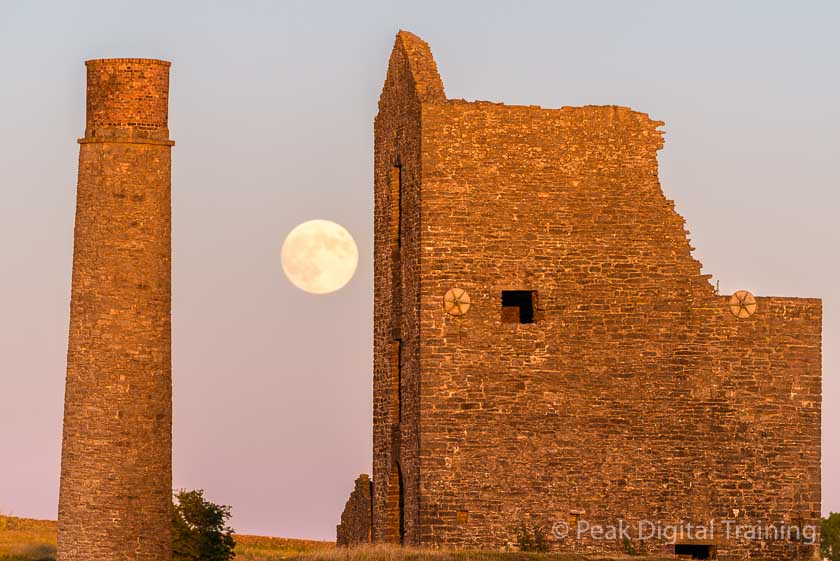
At certain times of the month, we can sometimes capture the full moon rising before the sun sets – so we can photograph both the moon itself as well as the buildings and other foreground features at the mine while they are still lit by daylight. This combination can produce spectacular images that require a minimum of post-processing.
Later, when it has got properly dark, we can get different shots with the buildings and landscape illuminated just by the light of the moon – which is also a relatively easy introduction to photography at night.
Here are some photos that clients have taken on previous courses at this particular location:


Our training can take place at any time of the year. However, late summer and autumn are particularly good as there are often some lovely evenings, with light winds, spectacular sunsets – and warm temperatures! As the evenings begin to draw in, we can often take full advantage of “golden hour” light, combined with the sunset and “blue hour“, as well as night itself – all during a single training session.
The photographic possibilities are obviously dependent on the weather and cloud conditions, but even if it’s cloudy, we can still get some great photos using combinations of natural light and “light painting” using flashguns and/or the lights that we can provide.
“many thanks for a brilliant low light/night workshop … I personally learned a lot that evening as did all the other participants and I respect that you keep your groups small so everyone gets your valuable help.” Stuart
This is an advanced level workshop. You must be able to set shutter speeds, apertures and ISO in fully manual (M) mode and be able to focus your camera manually – if you’re not able to do that, we would recommend coming on one of our landscape photography courses first to develop your skills.
You do not need any special equipment for this course, except that your camera must have a manual (M) exposure mode, and be able to take photos using long shutter speeds – ideally 30 seconds or even longer. Digital slr and mirrorless cameras should all be fine, but some compact cameras are also suitable (if you are in any doubt about the suitability of your camera, please contact us for advice). Wide angle lenses will be the most useful on this course – ideally with a maximum aperture of f2.8 or faster – but longer lenses may also be useful for pictures of the moon itself and the sunset.
A sturdy tripod is also an absolute must (though we will be able to lend you one if you haven’t already got one), and some sort of remote shutter or cable release would be useful (though not essential).
Apart from that, all you will need is a torch – both to help you set up your equipment in the dark and to use for light painting. LED torches are best, as their light is often close to the colour temperature of daylight, but any other torch will do – the more powerful, the better. If you have a flashgun (a separate one, not just the pop-up flash on your camera) that can be useful as well, though we can also provide some for you to use, as well as some wireless flash triggers and flash gels.
You can also see details of all the other landscape and beginners’ level photography courses we are currently running here.